




Building 21st-Century Rank-and-File Unionism

A small but important segment of the New Left “turned to industry,” getting jobs in steel, auto, and elsewhere to build a militant current in the US labor movement. The Rank-and-File Project is aiming to build a similar current of democratic, militant unionism today.
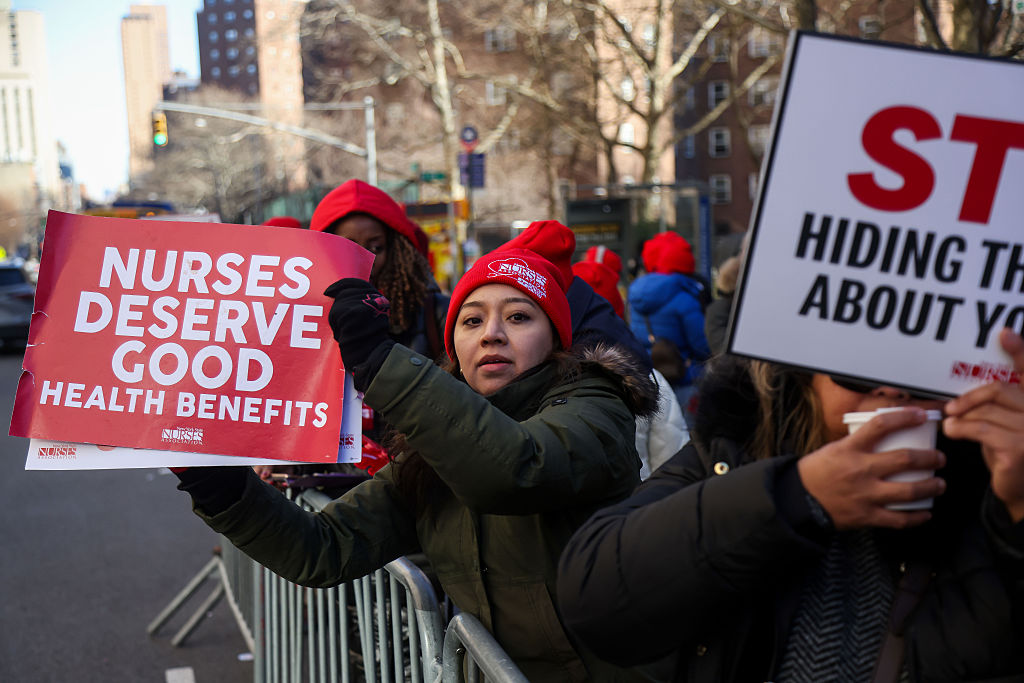
The Rank-and-File Project aims to get socialists to organize on the shop floor as rank-and-file workers, to help revitalize unions as part of a broader strategy of rebuilding working-class organizations. (Michael Nagle / Bloomberg via Getty Images)
In the late 1960s and early ’70s, a number of members of the American New Left that had incubated on college campuses in the prior decade set out to take rank-and-file jobs as blue-collar workers. The social and political ferment of the ’60s — including the women’s movement, the antiwar movement, the civil rights movement, and the Black Power movement — was reaching a fever pitch and was reflected in an upsurge of rank-and-file militancy in unions. Student activists, influenced by a variety of Marxist traditions and the venerable history of socialist and communist trade-union organizing, decided to try to integrate themselves with the industrial working class and foment class struggle from the shop floor.

These efforts ran into headwinds, including the personal difficulties activists had in sustaining their work as well as the broader political, social, and economic trends that marginalized the Left and hollowed out the labor movement. Johanna Brenner, a veteran of the New Left, wrote in 2023:
For the following three decades, as corporate capital restructured the U.S. economy, hollowing out the cities and industries that had been at the center of the rank and file project, as “socialism” continued to be a dirty word politically, as young people mostly turned away from the left . . . the stream of young radicals entering into working-class jobs for rank and file organizing ran dry.
Yet as Brenner notes, the legacy of that moment is important, both for the institutions it left behind — most notably, Labor Notes and the influential Teamsters reform caucus, Teamsters for a Democratic Union — and for the generation of left-wing activists with vital rank-and-file organizing experience it produced.
Throughout the neoliberal ’80s, ’90s, and early 2000s, labor and the Left were largely on the retreat. That changed in the 2010s as the tumult of Occupy Wall Street, Black Lives Matter, and Bernie Sanders’s presidential campaigns produced a revival of interest in both socialist ideas and the labor movement. Starting not long after Sanders’s 2016 campaign, sections of the new socialist left resolved to become rank-and-file workplace organizers in various unions and sectors that they deemed strategic organizing targets. In doing so, they drew on the lessons and arguments of earlier generations of activists, especially those who took directly to the shop floor in the 1970s.
Among the most ambitious initiatives on this front is the Rank & File Project (RFP), a national effort I’m involved with that launched in 2023 and seeks to recruit, train, and support young people to get union jobs in strategic sectors. As Cyn, a former member of RFP’s Steering Committee who is currently training to become a union nurse, summarized our motivations for Teen Vogue in 2024, “We believe that in order to transform the world, to fight for an ambitious, radical agenda, we need to build not just any kind of labor movement, but a strong, democratic, and increasingly left-wing labor movement.”
The context in which RFP’s activists and their fellow travelers are entering the workplace is very different from that of our New Left predecessors, let alone the heroic era of 1930s Communist labor organizing, in which radicals led massive strikes and helped build the major industrial unions. While there has been exciting organizing activity in many sectors in the past few years, and unions’ popularity is at a historic high point, labor union density is still shrinking. And Donald Trump continues to launch aggressive attacks on the rights of migrants, workers, and those who dare to speak out against the ongoing genocide in Gaza.
The dual tasks of building the labor movement and rooting socialism in the broader working class look more daunting than ever. But those tasks are also necessary as ever, and today’s rank-and-filers can draw on a long and vital history of similar activism for sustenance.
The Turn to Industry
The “turn to industry,” as it came to be called, is perhaps a lesser-known episode in the saga of the New Left. “They’ve really written the reality of the ’60s and ’70s out of history,” Jon Melrod, one such radical who became a rank-and-file autoworker in Milwaukee, told Jacobin in 2022.
You know about the Weathermen; you know about Patty Hearst — these kinds of things. You don’t know about the Revolutionary Youth Movement (RYM) II of Students for a Democratic Society (SDS), which immediately turned after the breakup of SDS to the working class and in support of the Black Panther Party and the black liberation movement. . . . At least ten thousand of them that we know went into organizing in the working class — working-class communities and industry.
The campus-based SDS was the central organization of the American New Left, which played a key role in student antiwar activism. As the 1960s wore on, the group became increasingly radical politically, and increasingly wracked by sectarian tensions. SDS blew up at its 1969 convention, splitting largely between different factions of self-described Marxist-Leninists.
One SDS faction, as Melrod mentions, went on to form the guerrilla group the Weathermen (later known as the Weather Underground). But other SDSers believed that young leftists should integrate themselves with the industrial working class on the shop floor, including, like Melrod, those in Maoist-inspired groups associated with the New Communist Movement. Another such activist was Elly Leary of the Proletarian Unity League (PUL), who took a job at a Boston-area General Motors factory in 1977. Reflecting on the experience in 2022, Leary wrote, “PUL always encouraged comrades to leave bourgeois jobs and go colonize [the jargon for cadre getting industrial jobs in targeted unions]. Like Marxist organizations everywhere, we held that the working class was the engine of social and revolutionary change.”
Among these Marxist organizations were also groups broadly in the Trotskyist tradition, including the International Socialists (IS). In his systematic study International Trotskyism, politics scholar Robert Alexander wrote that “the International Socialists would seem to be the Trotskyist group which was most successful in establishing some base in the organized labor movement in the 1970s.” It was the IS that was responsible, in 1979, for the creation of Labor Notes, the media outlet devoted to building, supporting, and cohering democratic, militant reform efforts in largely ossified unions; such efforts were seen as necessary for displacing entrenched leaderships that often advocated self-defeating “labor-management partnerships” and discouraged worker militancy. IS members also played key roles in building a number of reform caucuses like Teamsters for a Democratic Union (TDU), the long-running reform group in the Teamsters.
The movement of activists from these New Left groups into working-class jobs, and the groups themselves, largely fizzled in the ’80s. But the groundwork they laid, in terms of organizations like Labor Notes and TDU and the work of committed rank-and-filers who stuck it out for the long haul, helped fuel reform movements in major unions in the coming decades. The experiences and lessons of those activists, and the strategic framework they developed that came to be known as the “rank and file strategy” (RFS), ultimately became important to the new generation of radicals activated in the 2010s.
The basic idea behind the rank-and-file strategy, as laid out in a 2000 pamphlet of that name by former IS member Kim Moody, rested on a diagnosis of two problems. The first is that the American working class suffered from lack of organization, militancy, and consciousness, a situation partly due to unions’ long-standing failure to organize workers and actually defend their interests. The second is the separation of the mostly highly educated socialist left from the vast majority of workers and their class organizations.
The RFS seeks to solve both problems by advocating for socialists to organize on the shop floor as rank-and-file workers, to help revitalize unions as part of a broader strategy of building working-class organizations — including cross-union networks like Labor Notes, community-based groups, class-based political projects, and socialist organizations like Democratic Socialists of America (DSA) — that foster worker militancy and classwide consciousness.
The New Industrializers
Occupy and the Black Lives Matter protests of 2014 helped spur a new wave of left-wing radicalization of young people, its momentum surging and taking more solid organizational form with Bernie Sanders’s 2016 presidential campaign. In the wake of Sanders’s first run and then Trump’s first inauguration, thousands of new members flooded into the DSA, a social democratic holdover from the New Left era, transforming it into the country’s largest socialist organization and pushing its politics leftward.
Much of DSA’s work was focused on electoral politics, the activity that got it the most media attention. But many who joined DSA post-2016 saw connecting with and revitalizing the labor movement as a central task. These members — including some veterans of IS and successor organizations the International Socialist Organization (ISO) and Solidarity — pushed DSA to focus on labor work. At its recent national conventions, DSA has officially endorsed the RFS as its position on the labor movement.
Some local DSA chapters, like New York City DSA, coordinated efforts to get members into rank-and-file union jobs, and some members have taken such jobs on their own initiative. But much of DSA’s labor work has had a different focus. The Emergency Workplace Organizing Committee (EWOC), a joint project of DSA and the United Electrical Workers (UE) founded in 2020, connects volunteer activists with nonunion workers who are interested in organizing their workplaces. The Workers Organizing Workers (WOW) campaign, launched in 2023 by DSA’s National Labor Commission, is primarily recruiting DSA members to “salt” nonunion shops as part of extant organizing campaigns.
Though union density has continued to decline precipitously since the 1970s, the major national unions still command very significant financial and institutional resources. These resources — which unions have for the most part failed to actually put to use in organizing workers or supporting strikes, as Chris Bohner has documented — will likely be necessary, if insufficient, to revitalize organized labor.
Seeing the need for a dedicated national initiative to build a new generation of shop-floor activists seeking to transform unions into vehicles of class struggle and thereby build the socialist movement, as well as the potential for recruiting would-be activists outside of DSA, a number of us in the orbit of DSA and Labor Notes started the Rank & File Project in 2023. RFP is formally independent of DSA, though many if not most of its activists are also DSA members, and RFP has regularly cohosted and cosponsored events with the socialist organization. But RFP’s independence of DSA allows it to consistently prioritize and dedicate paid staff time to advancing the rank-and-file strategy, in particular through building a pipeline of young activists into shop-floor union jobs.
RFP is now in the middle of its second round of “Rank & File Schools,” which provides basic political education and organizing training for budding rank-and-filers. It has active cohorts in the San Francisco Bay Area, New York City, and Philadelphia. RFP also launched an initial cohort in Los Angeles, though we are not currently recruiting or running a Rank & File School there. The syllabus includes modules covering the Marxist analysis of class under capitalism, the centrality of the labor movement to winning social change, and guidance for activists in analyzing their unions and organizing their coworkers.
RFP’s activists are taking jobs in health care, education, logistics, construction, and public library work. These are sectors that the group has deemed strategic targets for one or more reasons. Some industries, such as logistics and construction, are targets because their workers directly wield outsize economic power: a strike at, say, UPS could cost billions of dollars in a matter of days. Other sectors are targets because their workers can exercise significant power in other ways: educators and nurses can cause massive disruption, and if they can get communities on their side for “common good” demands — as striking teachers often have in the last decade-plus in Chicago, West Virginia, Los Angeles, and elsewhere — they can win major concessions from political elites.
Relatedly, workers in some sectors have immediate material stakes in policy demands championed by socialists. Teachers have an interest in adequately funded public schools, for instance, and electricians are situated to benefit from and help guide a just green transition. Finally, some sectors have been targeted because they are already sites of established or nascent union reform and shop-floor organizing efforts. (The emphasis on “caring” occupations like teaching and nursing, examples of what Allison Pugh has called “connective labor,” marks a difference in approach from the ’70s generation of rank-and-filers, who focused more on manufacturing. And while RFP has collectively identified certain industries and unions as strategic, individual rank-and-filers are choosing which jobs to pursue based on their own personal interests and needs, rather than following the direction of a disciplined cadre group.)
The group has launched cohorts in cities where a critical mass of current and potential worker-organizers, as well as volunteer supporters, has been interested in starting pipelines into local workplaces in relevant sectors. All told, roughly one hundred rank-and-filers, or prospective rank-and-filers, have completed or are currently working through a Rank & File School curriculum. Activists who have completed the Rank & File School continue to meet with other members of their respective geographic and industry cohorts for political discussion and organizing support.
Getting to Work
Beyond affinity with our goals and strategy, many radicals have been drawn to the project because of the prospect of meaningfully integrating their political commitments with stable (if often very difficult) jobs.
“My pathway to becoming an education worker and organizer was a convergence of years of intensive political education and a personal discontent with my position in society — how distant politics felt absent from my professional life,” one RFP activist who wished to remain anonymous, a former urban planner turned public high-school teacher in New York City, told me.
Teaching is challenging for all the usual reasons: managing the moods of 150 teenagers, dealing with the impact of technology on attention spans, and supporting students through difficult personal situations. But beyond that, the biggest challenge is working within a system that is chronically underfunded and deeply neglected. . . . Despite all this, teaching is the most rewarding thing I’ve ever done. . . . Getting to work with working-class kids from Brooklyn — who instinctively understand the world in a way many so-called political experts don’t — is an absolute privilege.
In some cases, RFP activists are drawing on the guidance of mentors from earlier generations of “industrializers.” Tim Marshall, a public-school teacher in Oakland, California, and former member of Solidarity who started working as a teacher in the 1990s, is one such mentor. Marshall is hopeful that committed activists from RFP can empower his union, the Oakland Education Association. “More young radicals stepping up as site representatives would strengthen the union, ensuring leadership stays accountable to rank-and-file concerns,” Marshall says.
In other cities and unions across the country, a growing number of RFP activists are learning from rank-and-file veterans in teaching, nursing, construction, and more.
RFPers at the start of their organizing careers are keeping in sight their long-term ambitions for transforming their unions and building class struggle while focusing on the immediate tasks of forging relationships on the shop floor. “Rank-and-file organizing is tough. You’re tasked with convincing people they have the power to take on their boss, the capitalist class even,” says Ava Guerrero, a third-year teacher, also working in the New York City school system.
One doesn’t need to have all the answers or direct people to any single revolutionary campaign. It’s about learning your trade, being a trusted member of your workplace, and figuring out how to be a better version of yourself alongside others doing the same. Of course, we have our sights set on the big strike weapon. But all of the small moments of being there for the people around you matter when it comes to asking someone to do something big, like risk their job.
This important relationship-building work has included reviving cultures of regular socializing and communication at the individual school level. And as the Trump administration has launched a brutal campaign of repression against migrants, Ava and other RFP teacher-organizers have been involved in building community among teachers, immigrant students, and their families; hosting social nights; working to inform students of their rights in the event of raids by immigration authorities; and helping families come up with contingency plans in the event that students’ parents or guardians are detained. After rank-and-file teachers across New York took the initiative in this sort of organizing, the teachers’ union is now officially organizing meetings to discuss protecting immigrant students and workers. At other schools, RFPers have started becoming chapter-level officers.
RFP members in nursing are also starting down the path of building rank-and-file militancy in their own unions. RFP nurses have helped organize petitions and marches on the boss in defense of working conditions and patient safety at their hospitals; some of them were recently part of a successful effort to elect new leadership at the chapter level.
The goal of building a democratic, left-wing, and militant labor movement is both abstract and very long-term. What that means concretely, and in the shorter run, is something that varies by industry and union, and RFPers are developing their approach in practice. In some unions, the near-term goals include helping build existing reform caucuses to challenge entrenched, antidemocratic leaderships; in other places, rank-and-filers are seeking to build reform movements where there aren’t any. At the shop floor level, near-term goals range from building relationships with coworkers to organizing protests against harmful and unpopular management decisions to taking on shop steward roles — all things that RFP nurses and teachers in New York, for instance, are already doing.
The new generation of rank-and-filers is grappling with these thorny questions while learning the ropes of difficult new jobs, all in a hostile political environment. But whatever else is true of today’s social and political climate, it is one of ever-increasing disaffection with political and economic elites — fertile ground for frightening reactionary politics, to be sure, but also for a revival of the class-struggle unionism socialists hope to build.
“I joined the Rank and File Project out of a desire to see the working class reclaim power,” said Mase, a new nurse in the Bay Area. “Grassroots organizers, rank-and-file membership — this is how we stand up for and take care of each other.”
Tomado de jacobin.com

Más historias
Construyendo un sindicalismo de base para el siglo XXI
Backrooms and Obsession Are Glimpses of a Better Hollywood
Backrooms y Obsession son destellos de un Hollywood mejor