




Backrooms and Obsession Are Glimpses of a Better Hollywood

Two indie horror movies with YouTube origins, Obsession and Backrooms, crushed big-budget Star Wars and He-Man movies at the box office. But claims that these films represent a revival of cinematic creativity à la the New Hollywood era are overblown.
Backrooms and Obsession represent fluttering signs of life in a moribund film system that’s constantly threatening to flatline. (A24)
Everybody’s been talking and writing about the enormous box-office success and staying power of Backrooms andObsession, two low-budget horror films made by young directors who came to fame for their works on YouTube. Their startling feature film hits are being compared with the tanking of the new He-Man movie, Masters of the Universe, and the sinking profits of Star Wars: The Mandalorian and Grogu, a franchise spectacle that started strong and faded fast as bad reviews and scornful word-of-mouth warned off viewers.

Straw-clutching think pieces wonder, is this the proof of the long-anticipated studio collapse? Is New Hollywood 2.0 here at last?
Unlikely. But we can dream, can’t we? The protracted death throes of the old system are so depressing to witness it would be a mercy all around to shoot the sad old beast and put it out of its misery. Let the YouTubers take over. There’s something wonderfully unlikely about the transfer of YouTube video material back to the big screen after several decades of small-screen fare (aka “prestige TV”) siphoning off audiences from the cinema.
Plus both horror movies are surprisingly good. Backrooms is the more inventive and disturbing film, but Obsession offers a clever alternative to the be-careful-what-you-wish-for “Monkey’s Paw” narrative. The movies feature effective handling of eerie mise-en-scène, sharp offbeat editing, and memorable lead performances.
Horror Movies Still Work
The more conventional Obsession, written, directed, and edited by Curry Barker and reportedly made on a meager budget of $750,000, concerns a sad-sack young man named Baron aka “Bear” (Michael Johnston) who’s in apparently unrequited love with his far cooler music store coworker Nikki (Inde Navarrette). Fearing he’s been permanently “friend-zoned,” he buys a novelty wish-granting gizmo from a spiritualist store and uses it to wish that Nikki would love him more than anyone else in the world.
Immediately Nikki’s behavior changes, becoming alarmingly clinging and frantic, then turning murderously possessive. Navarrette’s powerhouse performance as the paranormally possessed Nikki, edged in a kind of ironic humor and awareness of playing a nightmarish male fantasy cliché, is getting her a lot of well-deserved attention.
Both horror films offer characters living dead-end lives in spaces that hark back to a more stable and prosperous past. Though that past seems appalling in a different way than the present — it’s a dead, used-up husk that haunts the living and foretells our doom. Backrooms is especially sensational because it finds a way to represent the United States in steep decline without prancing about it in any didactic way. It’s a terrifying reality we’re trapped in here, and twenty-year-old director Kane Parsons roots our shared angst in bleak spaces representing our desiccated nation grinding to a halt. Those spaces include the deserted ones of old analog America, circa the 1980s, that haunt the more precariously situated contemporary characters.
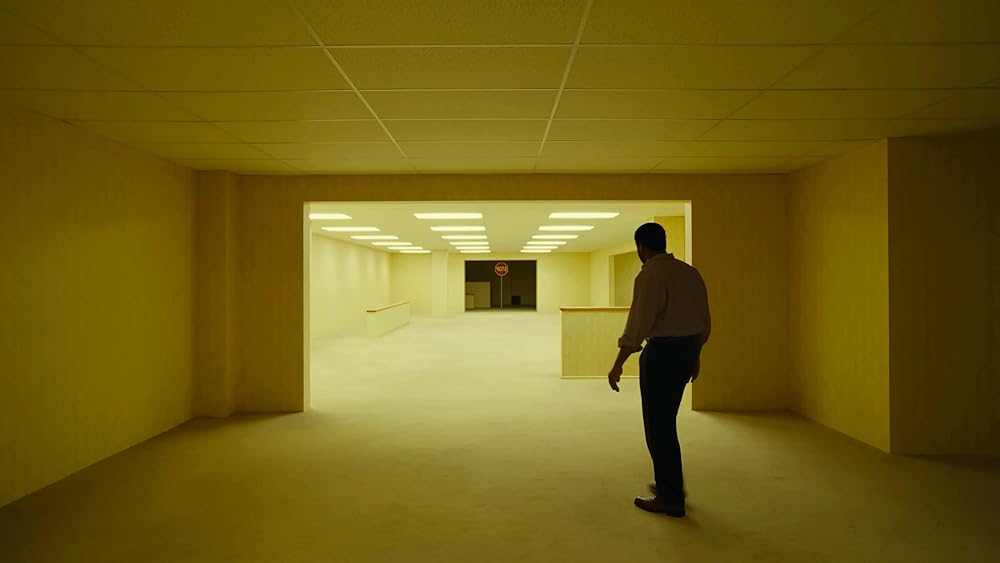
Those horror-infused spaces aren’t just the abandoned office buildings and commercial complexes — one beige box opening out from another in dreadful no-exit labyrinths — that Parsons made chillingly memorable in his inspired “creepypasta” web series on YouTube. No, the other ordinary but still terrible spaces are lived in and worked in by the main characters. There’s a reason these characters are willing to cross over into a kind of fourth-dimensional hell world of endless deserted space featuring low ceilings, stained tan carpets, no windows, and fluorescent lighting that casts an unwholesome sulfurous yellow glare on everything. And that’s because their own spaces are also dreadful — more insidiously dreadful because they’re still in use. But they’re deadening traps just the same.
Clark (Chiwetel Ejiofor of 12 Years a Slave) is the owner of a strip mall furniture store, one of those vast, flat, one-story, hugely depressing places loaded with the ugliest furniture ever seen, for sale at bargain rates. Its advertising takes the form of those frantic, pathetic TV ads boasting about “crazy” prices. Clark plays a peg-legged pirate character in these ads, sweating with humiliation while shouting nonsense about looting the store, and it’s no surprise that the ads don’t bring in any customers. Someone has spray-painted angry red graffiti on the storefront reading “RIP OFF.”
Clark is also living at the store, sleeping in one of the cheap for-sale beds, because his wife recently kicked him out of the house. It’s no wonder that his alcoholism has reached a drinking-directly-from-the-bottle stage. He’s seeing a therapist named Dr Mary Kline (Renate Reinsve of Sentimental Value), who gets him to express through role-play some of his bottled-up rage at his estranged wife, his apparently useless degree as an architect, his grim failing business, his money terrors, and the overall hopelessness of his plight.
His ordinary life is so grim, it figures that Clark is willing to explore at length the vast, forbidding limbo on the other side of one wall of his downstairs furniture storeroom. It’s no wonderland on the other side of this porous Alice Through the Looking Glass barrier. It’s apparently just old, abandoned office space from the 1970s or ’80s. But acres of it, miles of it, an eternity of the worst kind of interiors ever designed to torment a suffering workforce, and the farther you travel within it the stranger it becomes in terms of skewed angles and weirdly placed windows that open into more box-like rooms, never the outside world.
Confounding remainders of previous human activity appear in the form of heaps of clothing, frantic scribbles on the walls, a stop sign hung over one entryway, a cardboard cutout figure wired for audio that spews out corporate-speak in various languages. And then there are the disturbing sounds of distant movement that gradually coalesce into roaring, smashing, and a rhythmic tromping noise and gets suddenly, alarming louder. . . .
When Clark has been missing for some time, Mary Kline tries to figure out what happened to her client. We also get a look at her life, which is certainly more financially stable that Clark’s but has a similar entrapped quality to it. Her office and home spaces are anonymous, stultifying, deindividualized. Her life with husband and son has a creepy still-life tableau quality to it, as if they’ve become paralyzed while sitting on generic furniture staring at the TV. She has nightmares of her abusive childhood trapped in a house with her mentally ill mother.
Her practice is boosted by her book advertised on television in which she provides therapeutic wisdom about the way people become trapped in loops of habitual behavior, blocked behind metaphorical glass windows that aren’t locked and could be opened at any time. It’s a familiar line of therapy talk that always makes salvation an act of simple personal willpower, as if the toxic effects of living in a world of destructive systems were negligible factors. “Open the window,” she intones.
But what if a version of “the window” is a porous door-shaped area on a wall in a furniture storeroom that leads to an inexplicable netherworld? And that other world features “windows” everywhere that only open onto other rooms, never to the outside world?
The Terror of the 21st-Century American Landscape
The relationship between the dire life-sucking spaces and the therapy that’s wholly inadequate to address people’s entrapment within them lands, in the end, on an implied question of human psychology. Why did we ever construct societies, systems, and architectural dwellings and workspaces that no sane being would want to be in? Why did a majority of people ever consent to live such lives, and to pretend, en masse, that — as the meme dog in the burning room says — “This is fine”?
Some critics claim that Parsons doesn’t fully finesse the conclusion of Backrooms. But his film is so eerie and full of both dread and potential, it’s worth waiting for further Backrooms films to explore the implications of this one. And it’s no wonder audiences plus many critics are finding this film in particular to be an exciting new development.
But how significant a development is this? After all, moderately budgeted horror films have been one of the few solidly successful genres for quite a few years no. But the larger claims being made are considering YouTube as a whole new resource for the mainstream film industry to draw on. “The YouTube generation has finally come of age,” said horror director and producer James Wan, who coproduced Backrooms. “They grew up creating their own content with no money and just by being as creative as possible.”
Wan is hearkening back to the thrilling “new wave” of independent filmmaking in the 1980s and ’90s, when Hollywood discovered a ton of unaffiliated young filmmaker talent hiding in plain sight, making terrific low-budget movies on credit cards. Robert Redford’s serious-minded Sundance Film Festival exploded in size, importance, and commercial potential for Hollywood acquisitions teams as the most central showcase on the “film festival circuit” for rising young talent like the Coen brothers, Spike Lee, Steven Soderbergh, Mira Nair, John Sayles, and Jim Jarmusch.
YouTube is hardly a new media phenomenon and has long been engaged in promoting new talent. But the one-two punch of Backrooms and Obsession has created an outburst of proselytizing about a sudden new revelation. Soderbergh’s Sex, Lies, and Videotape had the same effect in 1989 when the roughly $1 million indie from an unknown Louisiana filmmaker was launched at the Sundance Film Festival, won the Palme D’Or at the Cannes Film Festival, and promptly made $36 million worldwide.
For anyone with a reasonably long memory, there’s an inclination to read this development, however welcome, as just the latest attempt to revive an industry that’s nevertheless been in steady decline for decades:
That’s part of the week’s Big Capitalist Lesson: that when it comes to finding “hot” filmmakers, YouTube is the new Sundance, or the new MTV, or the new whatever. And much will be said about how the aesthetic of “Backrooms” pours right out of the structural/atmospheric DNA of the web. (That’s less true of “Obsession.”) But if Hollywood really wants to take a lesson from the shocking success of these two movies, the message should be much larger than “Hip filmmakers with devoted web followings sell!”
As the American film industry, ever more reliant on proven IP product, finds that audiences might finally be getting pretty sick of the standard IP sources, if Masters of the Universe and Mandalorian and Grogu are any indication, there are other sources to draw on. Technically, Backrooms is an IP film, after all, whereas Obsession is an indie genre movie that came up the old-fashioned way, through film festivals.
Is This New Hollywood 2.0?
But for those who love cinema, there’s a dare-to-dream longing to think this might be bigger. Might we be on the cusp of something tremendous, a kind of New Hollywood 2.0? New Hollywood cinema, so-named in an essay by avant-garde filmmaker Jonas Mekas in 1962, involved an upsurge of creative and rebellious filmmaking from various international sources as Hollywood’s once all-powerful classic studio system was slowly sinking in the West. Hollywood had been sticking to its old ossified formulas and turning out big, disastrously expensive flops like Cleopatra (1963) and Doctor Dolittle (1967), when certain despairing studio executives got the bright idea of hiring a lot of young fresh not-at-all-established talent who might be able to appeal to the youth audience — the only audience still reliably going to the movies.
These filmmakers were drawn from newly established film schools, theater, television, and an earlier wave of independent film production — directors such as John Frankenheimer, Arthur Penn, Robert Altman, Francis Ford Coppola, Martin Scorsese, Steven Spielberg, and Hal Ashby. Their sensibilities were formed by tremendously influential European art film movements, the rise of militant experimental Third Cinema rooted in South American political liberation struggles that spread to three continents, new national cinemas springing up all over as colonizing governments were overthrown, and the rise of film programs in universities, all in the midst of roiling political revolt worldwide. Roger Corman’s microbudget independent filmmaking practices found a successful alternate route to popularity. Avant-garde and underground filmmaking movements that challenged cultural mores and censorship laws were flourishing.
And not often noted as part of the New Hollywood phenomena is how conditions such as the collapse of old censorship laws galvanized the gory, wildly inventive modern horror genre. British Hammer horror, the Italian giallo movies, and in America, George A. Romero’s Night of the Living Dead (1968), Peter Bogdanovich’s Targets (1968), and Tobe Hooper’s The Texas Chain Saw Massacre (1974) pointed the way forward. In short, there was so much going on in world cinema, various strains of creativity buoyed the foundering Hollywood studio system, reviving it enough to keep it going till the process of mergers and rising entertainment industry conglomerates could find new business models that were profitable.
But sadly for us, there’s nothing close to the protean conditions of that era fostering a new New Hollywood today. It’s hard to see how two hit horror movies like Backrooms and Obsession, no matter how low-budget and YouTuber-generated and praiseworthy, constitute a big sea change when moderately budgeted horror films have been one of the most reliably successful genres for ages. And big Marvel- and Star Wars–type films have been faltering and failing, between intermittent successes, for a few years now.
Still, even signs of the old IP exhaustion that also plagued 1960s Hollywood are heartening when combined with a new strain of anything remotely fresh and creative. For the moment, Backrooms and Obsession represent fluttering signs of life in a moribund film system that’s constantly threatening to flatline. Hope springs eternal among cinephiles.
Tomado de jacobin.com

Más historias
Backrooms y Obsession son destellos de un Hollywood mejor
La UFC se está degradando por Donald Trump
Líderes de Teamsters por una Unión Democrática explican su estrategia